

 Español
 Deutsch
Content
- 1 How to Choose a Plastic Storage Box Without Making Mistakes? Three Key Selection Criteria: Food-Grade PP Material, Sealing Performance, and Microwave Compatibility
- 2 Reusable Plastic Storage Box vs. Disposable Food Container: A Deep Comparison of Lifecycle Cost, Environmental Impact, and Usage Scenarios
- 3 Are Plastic Storage Boxes Suitable for Food Delivery? A Guide for Restaurants on Selecting Microwave-Safe Containers with Leak-Proof and Temperature-Resistant Performance
- 4 What Plastic Storage Box Is Best for Industrial Parts Organization? Selection Essentials for Drop-Resistant, Compression-Resistant, and Stackable Design in Factory Warehouse Classification Storage
- 5 How to Choose Plastic Storage Boxes for Home Freezer and Microwave Use? A Full-Scenario Safety Solution Covering -20°C to 120°C
How to Choose a Plastic Storage Box Without Making Mistakes? Three Key Selection Criteria: Food-Grade PP Material, Sealing Performance, and Microwave Compatibility
Direct Conclusion: When selecting a plastic storage box, prioritize confirming whether the material is food-grade PP (polypropylene), whether the sealing structure features a 360-degree surround locking design, and whether the temperature range covers -20°C to 120°C. Products meeting these three core indicators provide reliable assurance in safety, practicality, and durability. For desktop organization and bathroom storage scenarios, additional attention should be paid to ABS material waterproof performance and drawer slide smoothness.
Material Safety Is the Primary Threshold
Plastic storage boxes come into direct contact with food, making material safety the fundamental determinant of safe use. Food-grade PP (polypropylene) is widely recognized as the optimal choice in the industry, with a melting point exceeding 160°C. In microwave heating environments (typically not exceeding 120°C), it will not deform or release harmful substances. Compared to PS (polystyrene) material, PP contains no plasticizers and offers superior chemical stability.
When purchasing, check whether the product is labeled "food contact safe" or "BPA-free." BPA (Bisphenol A) is a chemical that may disrupt endocrine function; legitimate food-grade PP products have completely eliminated this component. Additionally, you can make a preliminary judgment by observing the box transparency: high-quality PP material presents a uniform semi-transparent white or natural color, while inferior recycled materials often appear dark with visible impurity spots.
For non-food-contact scenarios (such as office desktop organization and bathroom storage), ABS material is another excellent choice. ABS (Acrylonitrile Butadiene Styrene) features a tensile strength of 40-50 MPa, resisting cracking during daily handling, and is inherently waterproof, making it particularly suitable for high-humidity bathroom environments. Premium ABS materials undergo RoHS and REACH compliance testing to ensure non-toxic safety.
Sealing Performance Determines User Experience
The sealing structure is the key technical indicator that distinguishes high-end from low-end products. Premium plastic storage boxes adopt a 360-degree surround sealing ring combined with precision snap-fit design, effectively preventing liquid leakage and odor escape. A simple test for sealing performance: fill the container to 80% capacity with water, invert and shake for 30 seconds, and observe whether any water seeps from the lid seams.
| Sealing Grade | Structural Features | Leak-Proof Performance | Applicable Scenarios |
|---|---|---|---|
| Basic | Simple clasp, no sealing ring | Splash-proof, not invert-safe | Dry goods storage |
| Standard | Single-point clasp + silicone ring | Invert-safe for short periods | Daily meal prep |
| Precision | 360-degree surround locking + multi-seal | Fully leak-proof and spill-proof | Soups / food delivery |
For drawer-style desktop organizers, slide rail design equally impacts user experience. Premium products employ integrally molded slide rails (no metal parts), with pull-out force calibrated between 3-5 Newtons, ensuring smooth yet stable operation that will not rust or jam in humid bathroom environments.
Temperature Range Defines Usage Boundaries
Temperature resistance is the core indicator that determines the functional versatility of a plastic storage box. Products covering a -20°C to 120°C temperature range enable full-scenario use from freezer storage to microwave heating. Important note: when microwave heating, it is recommended to open the lid or loosen the snaps to avoid steam pressure buildup that could deform the container. Also avoid prolonged heating of high-oil or high-sugar foods to prevent localized overheating beyond the material's tolerance limit.
When purchasing, check the bottom marking of the product: the number "5" inside a triangular recycling symbol indicates PP material, often accompanied by "PP" or "5" and the temperature range. Products without markings should be purchased with caution, as they may involve unidentified material risks. For scenarios requiring stacking, also verify whether the product remains stable on a 15-degree incline platform under 15kg load, ensuring stability when vertically stacking 3-5 units.
Reusable Plastic Storage Box vs. Disposable Food Container: A Deep Comparison of Lifecycle Cost, Environmental Impact, and Usage Scenarios
Direct Conclusion: From a full lifecycle comprehensive assessment, reusable plastic storage boxes achieve a significantly lower per-use cost than disposable containers after exceeding 50 uses, while reducing plastic waste by over 90%. For high-frequency usage scenarios (daily use of more than once), reusable products offer clear economic and environmental advantages; for low-frequency or one-time scenarios, disposable containers remain more convenient. For precision management scenarios such as medication storage, detachable 7-day pill organizers far surpass ordinary pillboxes in medication adherence, reducing missed doses by over 70%.
Full Lifecycle Cost Calculation
Cost comparison should not focus solely on the initial purchase price but must incorporate usage frequency to calculate the per-use cost. Taking a standard 1-liter capacity plastic storage container as an example:
| Comparison Dimension | Reusable Storage Box | Disposable Container |
|---|---|---|
| Initial Cost | Higher (includes R&D and material costs) | Lower |
| Designed Usage Count | 50-100 times | 1 time |
| Per-Use Cost (after 50 uses) | Approximately 1/50 of initial price | Equals purchase price |
| Temperature Range | -20°C to 120°C | Typically 0°C to 70°C |
| Sealing Performance | High (precision clasp + sealing ring) | Medium-Low (simple locking) |
| Structural Strength | High (drop and compression resistant) | Low (easily deformed and damaged) |
Data shows that one reusable food-grade PP storage box can replace approximately 100 disposable containers throughout its complete lifecycle. For working families who pack lunches or store food daily, choosing reusable products can achieve cost equilibrium within three months.
Quantified Environmental Benefit Analysis
In environmental dimensions, reusable plastic storage boxes demonstrate even more significant advantages. According to industry calculations:
- Plastic waste reduction: Over 90%
- Full lifecycle carbon emission reduction: Over 60%
- Energy consumption reduction: By reducing repetitive production processes, comprehensive energy consumption decreases by approximately 45%
Although disposable food containers require no cleaning after single use, their cumulative environmental costs across production, transportation, and disposal far exceed those of reusable products. This is particularly true for disposable PS material containers, which have a temperature resistance limit of only about 70°C, cannot be microwave heated, have limited application scenarios, and offer low recycling value.
Special Scenario: Precision Management Needs for Medication Storage
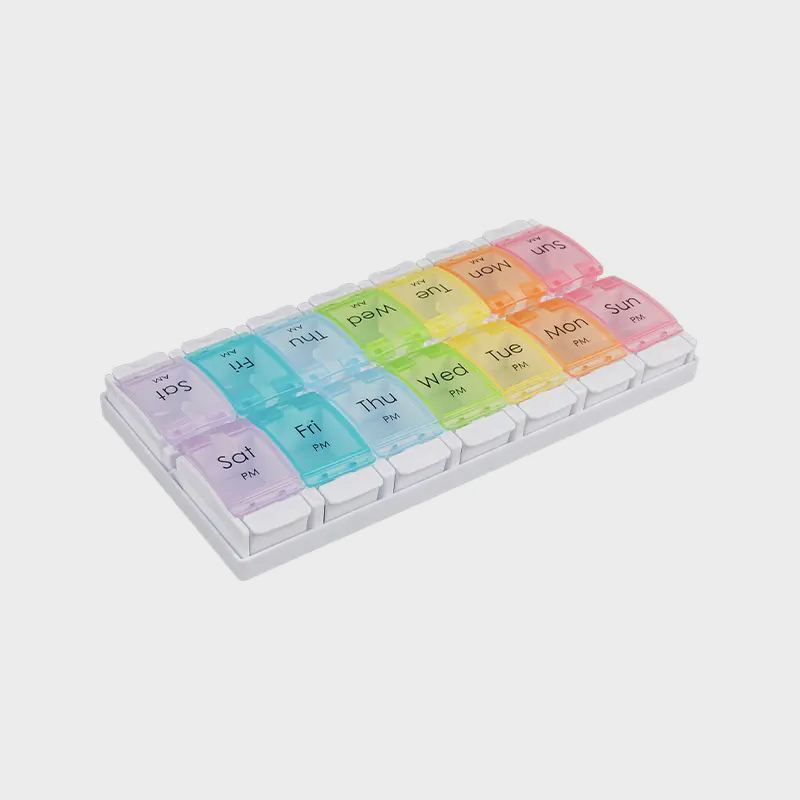
In the medication storage field, the advantages of reusable products become even more prominent. Taking the detachable 7-day pill organizer as an example, it employs food-grade PP material, BPA-free, with 14 independent compartments (morning and evening for 7 days), each compartment offering ample capacity for various sizes of tablets and capsules. The locking button opening mechanism is ergonomically optimized with moderate pressing force, enabling independent operation by elderly users.
According to user feedback statistics, using compartmentalized pill organizers can reduce missed doses by over 70%, significantly improving medication punctuality rates. The dual-row compartments can be detached from the base, allowing travel with only the single-row pillbox for corresponding days without carrying the entire unit, substantially saving luggage space. High-definition color printing employs a wear-resistant process, ensuring that day and time indicators remain clearly legible even after long-term use.
| Comparison Dimension | Detachable 7-Day Pill Organizer | Ordinary Pillbox |
|---|---|---|
| Compartment Planning | 7 days × 2 time zones, 14 independent compartments | Usually no partition or simple partition |
| Portability | Detachable single-row, carry as needed | Must carry entire box, fixed volume |
| Sealing Performance | Locking buttons, tight seal spill-proof | Simple flip lid, prone to loosening and spills |
| Material Safety | Food-grade PP, BPA-free, medical standards | Inconsistent materials, safety not guaranteed |
| Label Clarity | High-definition color printing, wear-resistant and durable | Blurry printing, prone to wear and peeling |
Scenario-Based Selection Recommendations
These two product types are not complete substitutes for each other; the choice should be based on actual usage frequency and scenarios:
- Prioritize reusable: Daily home meal prep, daily lunch packing for office workers, factory parts classification storage, retail display, elderly daily medication management, and other high-frequency fixed scenarios
- Consider disposable: Large temporary event catering, short-term business travel, medical waste disposal, and other special low-frequency scenarios
Are Plastic Storage Boxes Suitable for Food Delivery? A Guide for Restaurants on Selecting Microwave-Safe Containers with Leak-Proof and Temperature-Resistant Performance
Direct Conclusion: Food-grade PP microwave-safe plastic storage boxes are fully suitable for food delivery scenarios, but must meet three mandatory conditions: a temperature resistance upper limit of no less than 120°C, a 360-degree surround sealing and leak-proof structure, and food contact material safety certification. Products meeting these conditions can simultaneously ensure delivery safety and consumer reheating convenience. For intimate items such as underwear and socks, lidded designs also provide dual protection against dust and privacy exposure.
Special Requirements for Delivery Scenarios
The food delivery environment imposes more stringent requirements on containers than home use. During delivery, containers may experience tilting, jostling, or even inversion; sealing failure can cause soup spillage, directly impacting consumer experience and merchant reputation. Meanwhile, consumers typically expect to reheat delivered food directly in the microwave, requiring container materials to be microwave-safe.
Food-grade PP material demonstrates unique advantages in this scenario: its melting point exceeds 160°C, maintaining stability under conventional microwave heating temperatures (typically not exceeding 120°C) without softening, deforming, or releasing odors. In comparison, ordinary disposable PS containers have a temperature resistance limit of only about 70°C, posing safety risks during microwave heating and are gradually being phased out by the delivery industry.
Sealing and Leak-Proof Technical Essentials
Delivery containers must achieve precision-grade sealing standards. The core structure includes:
- Silicone Sealing Ring: An elastic sealing ring embedded inside the lid that generates uniform pressure when the clasp is locked, forming a 360-degree surround seal
- Multi-Point Clasp Structure: Four to six precision clasps distributed around the lid perimeter, ensuring even locking force distribution and preventing single-point failure
- Anti-Spill Diversion Channel: Micro diversion channels designed on the inner side of the lid that can redirect liquid back into the container even if the sealing ring experiences uneven pressure
In actual testing, precision-grade sealed containers filled to 80% capacity with soup, subjected to simulated delivery jostling (frequency 2Hz, amplitude ±15 degrees) for 30 minutes, controlled leakage within 0.5 milliliters, meeting delivery leak-proof requirements.
Temperature Performance and Microwave Heating Guidelines
When purchasing microwave-safe containers, restaurants should focus on verifying the following technical parameters:
| Technical Indicator | Minimum Requirement | Ideal Standard |
|---|---|---|
| Temperature Upper Limit | 100°C | ≥120°C |
| Temperature Lower Limit | 0°C | ≤-20°C |
| Sealing Grade | Standard (single-point clasp) | Precision (360-degree surround) |
| Material Certification | Food contact material compliant | BPA-free + third-party testing |
| Reusable Count | 10 times | ≥50 times |
Before bulk purchasing, merchants should request samples for actual microwave heating tests: fill with typical menu items (including soup), heat on medium-high microwave power for 3 minutes, and observe whether the container deforms, whether the lid pops up, or whether any odors are released. Only products that pass practical testing can ensure end-consumer usage safety.
Extended Scenario: The Value of Lidded Design for Intimate Item Storage
The sealing and lidded design of plastic storage boxes is equally critical in intimate item storage scenarios. Taking underwear and sock organizers as an example, independent lid designs can achieve dust reduction exceeding 80% while protecting personal privacy and avoiding exposure of intimate apparel. Thickened PP material box bodies are sturdy and durable, with smooth burr-free surfaces that will not snag delicate fabrics.
The large-capacity integrated compartment structure is specifically designed for personal items such as underwear and socks, enabling categorized storage that prevents mixing and makes retrieval and organization more convenient. Dimensions fit standard drawers, allowing direct placement in wardrobe drawers, bedside table drawers, or desk drawers without additional space modification. Multi-layer stacking design maximizes vertical space in wardrobes and bedside tables, improving storage efficiency. Multiple color customization options are supported to perfectly match home or dormitory decor styles.
| Comparison Dimension | Lidded Plastic Storage Box | Lidless Storage Box |
|---|---|---|
| Dust Prevention | Excellent, dust accumulation reduced by over 80% | Poor, prone to dust buildup requiring frequent cleaning |
| Privacy Protection | Strong, avoids exposure of intimate apparel | Weak, items visible at a glance |
| Stacking Stability | High, lid provides flat support surface | Low, prone to sliding and tipping |
| Space Neatness | High, uniform and aesthetically pleasing appearance | Low, visually cluttered |
| Applicable Scenarios | Bedroom, dormitory, closet, entrance | Open storage shelves, temporary storage |
What Plastic Storage Box Is Best for Industrial Parts Organization? Selection Essentials for Drop-Resistant, Compression-Resistant, and Stackable Design in Factory Warehouse Classification Storage
Direct Conclusion: Industrial scenarios require plastic storage boxes with wall thickness of no less than 2.5mm, impact-resistant modified PP material, and nested stacking structure. Such products remain undeformed under stacking pressures exceeding 50kg, do not crack when dropped from 1 meter onto concrete surfaces, and maximize warehouse space utilization through standardized dimensions. For multi-scenario universal needs spanning office, school, and bathroom environments, 3-tier transparent drawer ABS organizers represent the optimal solution balancing aesthetics and functionality.
The Rigorous Challenges of Industrial Environments on Storage Boxes
Factory warehouse environments differ fundamentally from home kitchens in their demands on storage boxes. Industrial containers must address the following challenges:
- Mechanical Impact: Collisions and drops during handling, plus accidental compression from forklift operations
- Stacking Load: In three-dimensional warehouse storage, bottom containers must bear the full weight of upper layers, with loads reaching 50-200kg
- Chemical Exposure: Potential contact with lubricants, cutting fluids, cleaning agents, and other industrial chemicals
- Temperature Fluctuation: Unair-conditioned warehouses may exceed 50°C in summer and drop below -10°C in winter
Standard household-grade plastic storage boxes typically have wall thickness of only 1-1.5mm, making them highly susceptible to deformation and rupture in industrial environments. Industrial-grade products require enhanced PP materials, with some high-end products adding glass fiber or elastomer modifiers to improve impact strength and fatigue resistance.
Core Parameters for Structural Strength
When selecting industrial plastic storage boxes, focus on the following structural parameters:
| Parameter Item | Household-Grade Standard | Industrial-Grade Requirement |
|---|---|---|
| Wall Thickness | 1.0-1.5mm | ≥2.5mm |
| Impact Resistance | General | No cracking at 1-meter drop |
| Stacking Load Capacity | 10-20kg | ≥50kg |
| Chemical Resistance | Weak (only household cleaners) | Oil, acid, and alkali resistant |
| Temperature Range | -20°C to 120°C | -30°C to 130°C |
Stackable Design and Warehouse Efficiency
The core demand of industrial warehousing is maximizing space utilization. Premium industrial storage boxes adopt a nested stacking design: empty boxes can nest inside each other to reduce void volume; when fully loaded, they can stack vertically with stability, with bottom boxes dispersing pressure through rib-reinforced structures. Standardized dimensions (commonly 600×400mm Euro-standard logistics box series) enable seamless integration with shelving, pallets, and conveyor lines.
Practical application data shows that warehouses using standardized nested stacking storage boxes can improve space utilization by 25%-40% compared to non-standard containers, with picking efficiency increasing by approximately 30%. Some products also feature transparent side windows or label slots for rapid content identification, reducing the frequency of opening boxes for inspection.
Multi-Scenario Extension: Office/School/Bathroom Desktop Organization Solutions
The selection logic for industrial-grade storage boxes equally applies to multi-scenario universal organization needs. For office, school, home desktop, and bathroom storage, 3-tier transparent drawer ABS organizers represent the optimal solution balancing aesthetics and functionality. Their core advantages include:
- 3 Independent Transparent Drawers: Categorized storage for stationery, cosmetics, toiletries, etc., with transparent design providing clear visibility and eliminating search time
- Non-Toxic ABS Material: Waterproof and durable, resistant to rust and deformation in high-humidity bathroom environments, RoHS and REACH compliant
- Stackable Vertical Design: Interlocking structure supports vertical towers of 3-5 units without tipping under 15kg load on a 15-degree incline, freeing surface space in compact areas
- Pure White Minimalist Finish: Strong decorative appeal, suitable for corporate gifting, with logo customization supported
Corporate procurement typically orders 50-500 units with logo customization, while educational institutions procure through wholesale channels before semester starts. Market trends indicate manufacturers are increasing recycled ABS content to 20%-30% while reducing unit weight by 10%-15% through lightweighting design to lower shipping costs.
| Inspection Item | Inspection Method | Pass Standard |
|---|---|---|
| Raw Material | FTIR spectroscopy, RoHS screening | 100% virgin ABS, non-toxic |
| Dimensional Accuracy | CMM coordinate measuring machine | ±0.5mm in critical fit areas |
| Drawer Slide | Pull-out force gauge | 3-5N smooth operation |
| Stack Stability | Incline platform test | No tip at 15° with 15kg load |
| Surface Finish | Visual inspection, gloss meter | Gloss 80-90 GU, no defects |
How to Choose Plastic Storage Boxes for Home Freezer and Microwave Use? A Full-Scenario Safety Solution Covering -20°C to 120°C
Direct Conclusion: For full-scenario home use, plastic storage boxes must be food-grade PP material products with a temperature range covering -20°C to 120°C, complemented by precision sealing structures. Such products enable direct microwave reheating immediately after removal from the freezer without thawing, creating a seamless chain from "freezing-storage-heating-serving" and eliminating cross-contamination risks from mid-process container switching. For items requiring fine classification management such as medications and underwear, detachable compartment structures and lidded partition designs can significantly improve management efficiency.
Technical Requirements for Freezing Scenarios
Home freezer compartments are typically set around -18°C, with rapid freeze functions reaching -24°C. Plastic storage boxes in this environment must meet the following requirements:
- Low-Temperature Toughness: PP material maintains certain toughness at -20°C without embrittlement or cracking. Inferior PS material becomes brittle below 0°C and shatters upon impact
- Freeze-Resistant Sealing: Sealing rings must resist low-temperature hardening; premium silicone sealing rings maintain elasticity at -30°C, preventing food dehydration from moisture sublimation during freezing
- Capacity Reserve: Liquid ingredients expand approximately 9% in volume after freezing; fill level should not exceed 80% of container capacity to prevent box rupture
Practical recommendation: Label the lid with date and contents before freezing, and manage inventory using a "first-in-first-out" principle. Transparent or semi-transparent containers facilitate quick identification, reducing temperature fluctuations from repeated lid opening.
Safety Guidelines for Microwave Heating
The transition from freezing to microwave heating imposes dual demands on material and structure. Key safety usage points for food-grade PP material in this scenario:
- Pre-Heating Preparation: After removing from the freezer, loosen the lid clasps or completely remove the lid before heating to avoid steam pressure buildup that could deform the container or cause the sealing ring to pop out
- Power Control: For initial heating, use medium power (50%-70%) for 2-3 minutes, observe the container response, then adjust accordingly
- Content Limitations: Avoid prolonged heating of high-oil (such as fried foods) or high-sugar (such as syrup) items, as localized temperatures may exceed 140°C, beyond PP's safe range
- Inspection Cycle: After exceeding 50 uses, regularly inspect whether the container shows whitening, deformation, or sealing ring aging, and replace promptly when reaching end of service life
Full-Scenario Adaptation Recommendations
For different home usage scenarios, configure storage box sets by capacity and function:
| Usage Scenario | Recommended Capacity | Core Functional Requirements |
|---|---|---|
| Frozen Meat / Seafood | 1-2 Liters | Deep-freeze sealing + capacity reserve |
| Leftover Microwave Reheating | 0.5-1 Liter | Microwave-safe + vented design |
| Dry Goods / Grain Storage | 2-5 Liters | Moisture-proof sealing + transparent visibility |
| Bento Lunch Packing | 0.8-1.2 Liters | Compartment design + lightweight leak-proof |
| Fruit / Vegetable Fresh Keeping | 1-3 Liters | Micro-ventilation + refrigeration optimization |
Fine Classification Management: Specialized Solutions for Medications and Intimate Items
For items requiring fine classification management, specialized designs of plastic storage boxes can substantially improve management efficiency. Taking medication management as an example, the detachable 7-day pill organizer employs a 14-compartment design (7 days × 2 time zones), with each compartment independently sealed against moisture, dust, and contamination. The locking button pressing force is ergonomically calibrated, enabling easy operation by elderly users with limited finger strength, with a pressing lifespan reaching thousands of cycles or more.
For underwear and sock storage, lidded thickened PP organizers feature a large-capacity integrated compartment structure; standard models can hold 10-15 pieces of underwear or 15-20 pairs of socks. The categorized partition design gives each item its own space, preventing deformation from stacking compression while enabling quick retrieval. Lids provide dust protection and privacy, with dimensions fitting standard drawers for direct placement without additional space modification.
By uniformly selecting food-grade PP material products with a -20°C to 120°C temperature range, households can achieve one set of containers covering all scenarios, reducing container type clutter and improving kitchen management efficiency. For cleaning and maintenance, these products support dishwasher high-temperature program cleaning (recommended placement on the top rack), or hand washing with neutral detergent. Avoid steel wool scrubbing to prevent surface scratching that could affect service life. Pill organizers should be cleaned weekly with warm water and neutral detergent, ensuring all compartments are completely dry before placing medications inside to prevent moisture buildup.