

 Español
 Deutsch

If you are sourcing food containers, storage boxes, cups, or cake packaging, the manufacture of plastic containers comes down to four decisions: resin grade, process route, mold quality, and quality-control discipline. The cheapest quote is rarely the lowest total cost. A container that leaks, cracks at the hinge, or fails a food-contact review will cost more in returns, rework, and delayed shipments than the few cents saved at the molding machine.
This guide explains how plastic containers are manufactured, where tolerances matter, how to compare quotes, and what to verify before placing an order. It is written for importers, restaurant suppliers, brand owners, and procurement teams that need repeatable quality rather than one-off samples.
What the Manufacture of Plastic Containers Actually Involves
Plastic container manufacturing is a chain, not a single step. It starts with a use case and ends with packed, traceable goods.
- Define the container: capacity, shape, lid type, sealing method, temperature range, and food-contact requirement.
- Select resin and additives: PP, PET, PS, or another food-grade polymer, plus colors and any recycled content.
- Design and build the mold: cavity layout, runner, cooling, ejection, and hinge or latch geometry.
- Run the process: injection molding, thermoforming, or blow molding, followed by trimming, printing, and assembly.
- Inspect and pack: dimensional checks, leak tests, migration documentation, and carton labeling.
The conclusion is simple: two suppliers can use the same resin and still produce different containers. The difference is usually tooling and process control.
Injection Molding, Thermoforming, and Blow Molding
Choose the process before you finalize the container design. Each route has different tooling economics and tolerance behavior.
| Process | Best for | Tooling cost | Wall thickness control | Typical containers |
|---|---|---|---|---|
| Injection molding | Precision lids, locking tabs, thick-walled reusable boxes | Higher | Excellent | Fresh-keeping boxes, bento boxes, storage bins |
| Thermoforming | Thin-wall disposable trays and cups at high volume | Moderate | Good | Fast-food boxes, party plates, cake bases |
| Blow molding | Hollow bottles and large jugs | Moderate to high | Moderate | Bottles, jars, large liquid containers |
Injection molding gives the best control over hinges, snap fits, and thread details. Thermoforming is often more economical for single-use food containers because the mold is simpler and the cycle is fast. Blow molding is not usually the right route for a food box with a lid, but it matters if your project includes bottles or jugs.
Material Choice: PP, PET, PS, and Food-Contact Compliance
Polypropylene (PP) is the default for reusable food containers, microwave-safe lunch boxes, and locking lids. It tolerates heat, resists stress cracking, and can be colored or made transparent with the right grade. PET is common for cold cups and display packaging because it is clear and strong, but it has lower heat resistance. PS is used for disposable cups, plates, and cold-food trays; it is rigid and inexpensive but not suited to hot filling or microwave use.
“Food grade” is not a single badge. Ask for the resin grade, migration test report, and a declaration of compliance for the target market. If the container will hold oily or acidic food, verify that the test conditions match that use. For an airtight storage container, the gasket material matters as much as the plastic body; a weak seal will shorten shelf life even if the PP is perfect.
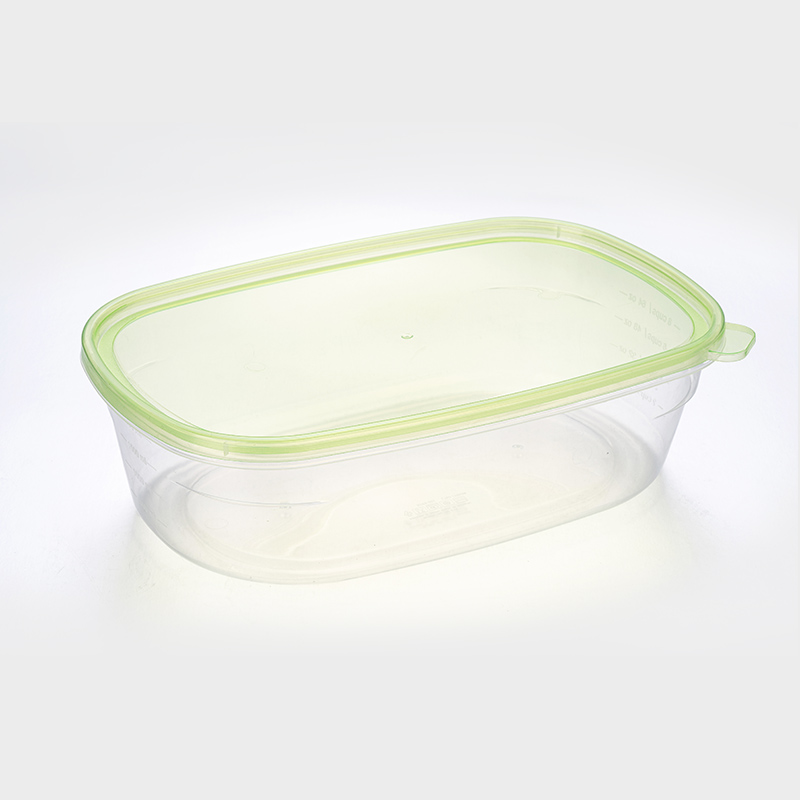 PFB015 Rectangular Airtight Stackable PP Food Storage ContainerFood-grade PP and silicone gasket construction make this customizable 2.4 L container relevant for airtight, stackable kitchen and refrigerator storage.View Product →
Tooling, Tolerances, and the Hidden Cost of a Weak Mold
A weak mold is the most expensive shortcut in plastic container manufacturing. It may pass the first sample and fail after 50,000 shots, producing flash, warped lids, or inconsistent latch force. Before you approve a tool, confirm the steel grade, number of cavities, cooling layout, ejection system, and expected maintenance plan.
- Lid fit: define the opening force and closing force, not just “tight.”
- Wall thickness: set a nominal value and a tolerance range; thin walls reduce weight but can reduce drop strength.
- Warpage: check flatness on the sealing surface, especially for rectangular containers.
- Gate location: it affects flow marks, weld lines, and transparency.
- Mold ownership: state who owns the tool and whether it can be transferred.
For multi-cavity tools, ask for a cavity-pressure balance report. A mold that fills unevenly will produce different part weights, and that variation shows up later as leaks or stackability problems.
Cost Drivers and Order Economics
The unit price is only one line in the landed-cost calculation. The larger drivers are resin, cycle time, cavitation, scrap rate, packaging, freight, and compliance testing. A quote that omits one of these is not comparable.
| Cost driver | Effect on price | What to ask |
|---|---|---|
| Resin grade | Food-grade and recycled grades can cost more than generic resin | Which grade, supplier, and documentation? |
| Cycle time | Longer cooling or thicker walls reduce output | What is the quoted cycle and cavitation? |
| Scrap rate | High reject rates are often hidden in the price | What reject rate is assumed in the quote? |
| Tooling | Amortized or charged upfront | Is the tool cost included, and who owns it? |
| Packaging and freight | Container nesting and carton size affect shipping | Can the design nest to reduce volume? |
Order quantity changes the economics more than most buyers expect. Tooling, setup, and color changes are fixed costs. If the annual volume is low, an off-the-shelf container or a shared mold may be more sensible than a new custom tool.
OEM/ODM Versus Off-the-Shelf Containers
Custom manufacturing makes sense when your brand needs a specific capacity, lid, color, or logo, or when the container must fit an existing rack, warmer, or delivery bag. Off-the-shelf containers are faster and cheaper for testing a market. The practical rule: customize the parts that touch the customer experience, and standardize the parts that only affect internal handling.
A capable OEM/ODM partner should handle design review, rapid prototyping, mold trials, food-contact documentation, and mass production under one quality system. If you want to see how a factory organizes those steps, review the manufacturing and quality-control process before you ask for a quote.
Sustainability and Circular Economy Claims
“Recyclable” means the container is technically recyclable, not that it will be recycled where your customer lives. PP and PET have established recycling streams in many markets, while PS and mixed-material lids are often harder to process. If sustainability is part of your specification, move from a slogan to measurable questions: recycled content percentage, mono-material design, label and gasket compatibility, and available certification.
The circular-economy discussion in packaging is shifting from material choice alone to design for sorting and reuse. A reusable container with a durable hinge and replaceable gasket can have a lower lifetime impact than a thin disposable item, but only if it survives repeated washing and handling. Industry guidance on sustainable packaging and circular economy is useful when you need to align a procurement policy with real end-of-life options.
Common Procurement Risks and How to Reduce Them
Most failures in plastic container procurement are predictable. They appear when the specification is vague or when the supplier is chosen only on price.
- Resin substitution: a supplier swaps a food-grade grade for a cheaper one. Use pre-shipment samples and lot traceability.
- Tool transfer disputes: clarify mold ownership and access before production starts.
- Thin walls: they save grams but reduce top-load strength and drop performance.
- Leak paths: check the seal after vibration and temperature cycling, not just on the bench.
- Missing documents: food-contact declarations, test reports, and certificates should be available before shipment.
- Unrealistic lead times: tooling, sampling, and mass production are separate schedules.
Reduce risk with a three-stage approval: design freeze, mold trial with dimensional report, and pre-production run using the actual resin and packaging. That sequence costs less than a failed container load.
How to Choose a Manufacturing Partner
Choose a partner that controls the mold, the process, and the inspection record. A trading company may offer a lower headline price, but it adds a communication layer when a tolerance problem appears.
- Can they show a mold-maintenance schedule and spare-cavity plan?
- Do they run food-contact compliance tests for your target market?
- Can they mold, print, assemble, and pack in one facility?
- Do they measure wall thickness and lid fit during production, not only at final inspection?
- Can they scale from a trial order to repeat shipments without changing the tool?
Ask for the process capability for critical dimensions. For a locking lid, the critical dimension may be the latch engagement; for a stackable box, it may be the base footprint. A supplier that can name those dimensions is usually managing the process rather than just selling parts.
FAQ
What does the manufacture of plastic containers involve?
It involves resin selection, tool design, one or more forming processes, assembly, inspection, and packaging. The exact sequence depends on whether the container is injection molded, thermoformed, or blow molded.
How do I know a plastic container is food-safe?
Look for a food-contact declaration, migration test results, and a resin grade suitable for the intended food, temperature, and duration of contact. A general “food grade” statement is not enough for regulated markets.
Should I choose a reusable or disposable container?
Choose disposable for high-turnover delivery and events where retrieval is impractical. Choose reusable when the container will be washed, refilled, or used by the same customer many times, and when the hinge and seal can survive repeated cycles.
What affects the minimum order quantity?
MOQ is driven by tooling, color changes, packaging setup, and raw-material purchasing. Custom colors and printed lids usually raise the minimum; natural or standard colors are more flexible.
Can I customize the shape, color, and logo?
Yes. OEM and ODM programs can adjust capacity, wall thickness, lid style, venting, color, and printing. The practical limit is usually tooling cost and the volume needed to amortize it.
For a reliable manufacture of plastic containers, start with the use case and work backward: food-contact requirement, process route, resin grade, tool design, and inspection plan. The container is only as good as the mold that formed it and the quality system that checked it. If a quote looks unusually low, find out which of those steps has been reduced. Then ask for samples, dimensional data, and compliance documents before you commit to production.